
ADHD is one of the most misunderstood conditions in mental health. It is not a lack of willpower, intelligence, or character, and it is not just “being hyper.” ADHD is a difference in how the brain’s attention and motivation systems are wired and chemically tuned. Understanding that difference replaces years of shame with something far more useful: a strategy. Here is what the science actually shows, reviewed by a Licensed Clinical Social Worker.
An attention system tuned differently
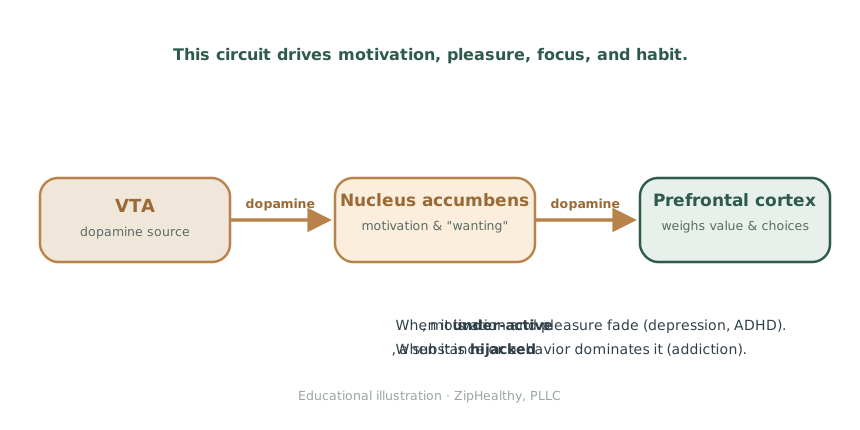
The brain’s prefrontal cortex runs what scientists call executive function: planning, prioritizing, starting tasks, holding things in mind, and resisting distraction. In ADHD, these prefrontal networks tend to mature later and regulate less consistently. The result is not an inability to focus, but difficulty directing focus on demand, which is why someone with ADHD can be scattered on a boring task and intensely locked in on an interesting one.
It runs on dopamine
The other half of the story is chemistry. ADHD involves differences in dopamine and norepinephrine signaling in the brain’s reward and attention circuits. Dopamine is the brain’s “this matters, pay attention” signal. When that signal is tuned differently, ordinary-but-important tasks don’t generate enough pull, while novel, urgent, or stimulating ones do. This is the neuroscience behind an “interest-based” attention system.
Why effort doesn't fix it
Because the difference is in the brain’s self-regulation machinery itself, “just try harder” doesn’t work: the part of the brain being asked to try harder is the part that works differently. This is also why people with ADHD are so often exhausted: they are running extra effort all day to do what other brains do automatically.
The myth
ADHD is just laziness or bad parenting, and you’d focus fine if you really wanted to.
What the science says
ADHD is a well-established, highly heritable neurodevelopmental difference in brain structure, function, and chemistry, recognized by every major medical body.
The strengths side
The same wiring that makes routine hard can bring real strengths: creativity, energy, the ability to hyperfocus on what fascinates you, and out-of-the-box problem-solving. The goal of treatment isn’t to erase an ADHD brain: it’s to build scaffolding so its strengths come through and its costs come down.
The three systems ADHD touches
It helps to be specific about what “executive function” actually means day to day. ADHD tends to affect three related systems, all run by the prefrontal networks:
Attention regulation
Not a shortage of attention but difficulty directing it, drifting on the dull and important, locking on (hyperfocus) to the novel and interesting.
Impulse & inhibition
A smaller gap between urge and action: blurting, interrupting, impulsive spending or decisions, difficulty waiting.
Working memory & time
Holding steps in mind and sensing time are harder: the “out of sight, out of mind” effect, lost keys, and the classic ADHD relationship to deadlines.
Seen this way, the scattered, last-minute, “I know what to do but can’t make myself do it” experience isn’t a values problem. It is these three systems working differently, and each can be supported with the right scaffolding.
Why the reward system makes “boring” so hard
There is a reason an ADHD brain can write a novel overnight but not start a 20-minute form. Because dopamine signaling is tuned differently, the brain registers interest, novelty, challenge, and urgency as “worth it,” while routine, low-stimulation tasks barely move the needle, no matter how important they are. This is why willpower-based plans fail and why effective strategies work with the reward system: breaking tasks down, adding novelty or stakes, body-doubling, and making the next step concrete and immediate.
ADHD rarely travels alone
After years of falling short of expectations, despite real effort, many people with ADHD develop a layer of anxiety, low self-esteem, or depression on top of the core differences. Sleep problems and emotional sensitivity are common too. This matters for treatment: addressing only the attention piece, or only the anxiety piece, often falls short. Good care treats the whole picture.
What helps
Because ADHD is about regulation, the most effective approaches build external structure for internal systems: skills coaching, environmental design, routines and reminders that offload working memory, and therapy for the anxiety, low self-esteem, or overwhelm that often come along after years of struggle. Treating the brain kindly (protecting sleep, movement, and stress) also directly supports the prefrontal systems involved. For many people a prescriber also recommends medication; decisions about medication belong with your physician, and we coordinate care around it.
Frequently asked questions
Is the ADHD brain really different?
Yes. Research shows differences in the development and activity of prefrontal attention networks and in dopamine signaling. ADHD is one of the most well-validated conditions in psychiatry.
Can adults have ADHD if they did well in school?
Absolutely. Many bright people compensate for years until demands outgrow their workarounds, often in college, a new job, or parenthood. ADHD frequently goes unrecognized, especially in those who are inattentive rather than hyperactive.
Does therapy help ADHD, or only medication?
Both have roles. Skills-based therapy and coaching build the external structure ADHD brains benefit from and treat the anxiety or low self-worth that often accompany it. Medication, when a prescriber recommends it, works on the underlying chemistry. Many people do best with a combination.
Will my child grow out of it?
ADHD often continues into adulthood, though how it shows up changes. The good news is that skills, support, and (when appropriate) treatment make a large, lasting difference.
Put it into practice
ADHD Focus & Organization Toolkit
Focus strategies, organization systems, and executive-function tools designed by a neurodivergent-affirming therapist.
Get the Toolkit: $34.99Instant PDF download · Designed by a licensed clinician
For educational and personal development purposes. Not a substitute for professional therapy.
References
- National Institute of Mental Health (NIMH). Attention-Deficit/Hyperactivity Disorder (ADHD). nimh.nih.gov
- Centers for Disease Control and Prevention. About ADHD. cdc.gov
- MedlinePlus, U.S. National Library of Medicine. Attention Deficit Hyperactivity Disorder. medlineplus.gov
- American Psychological Association. ADHD. apa.org