
“How can talking change anything?” It is one of the most common questions I hear, and the answer is one of the most hopeful facts in modern neuroscience. Therapy is not just talking. It is structured practice that physically reshapes the brain’s circuits, the same way exercise reshapes a muscle. Here is how that works.
Your brain is built to change
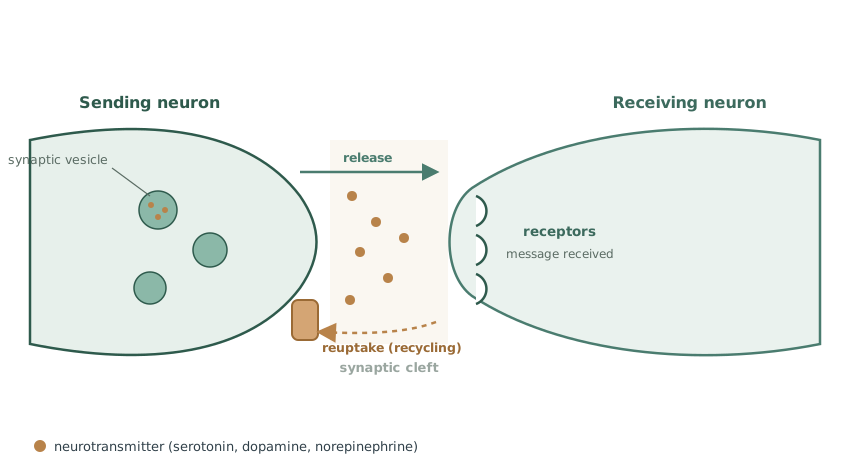
The brain’s ability to rewire itself in response to experience is called neuroplasticity. Every time you learn something or practice a new response, connections between neurons, synapses, strengthen or weaken. Therapy harnesses this on purpose: it gives the brain repeated, structured experiences that teach it new patterns.
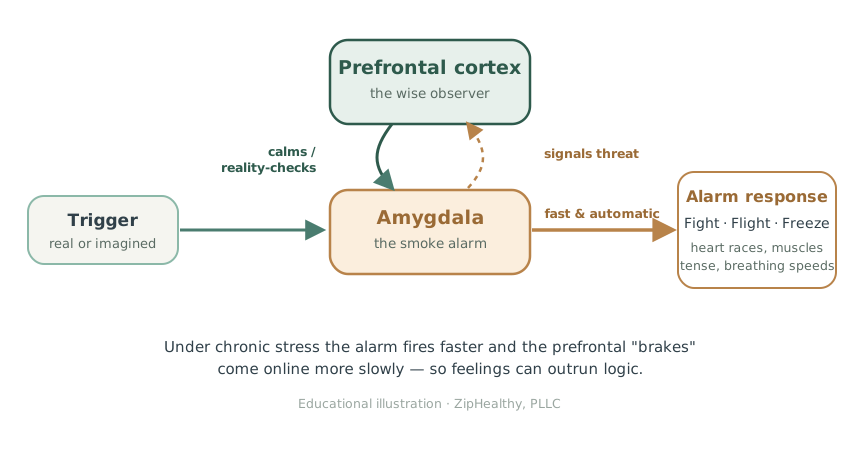
How therapy retrains the fear circuit
In anxiety and trauma, the amygdala’s alarm fires too easily while the prefrontal cortex is slow to calm it. Approaches like cognitive behavioral therapy (CBT) and exposure therapy work directly on this circuit: by facing fears gradually and safely, you teach the amygdala new “this is safe” associations and strengthen the prefrontal cortex’s ability to apply the brakes. Over time, the alarm fires less, and regulation comes faster.
The key reframe: therapy is practice, not a pep talk. Each session and each between-session exercise is a rep that, repeated over time, changes how the brain’s circuits fire.
Different therapies, different targets
CBT
Retrains the thinking-feeling-behavior loop and strengthens prefrontal regulation of the alarm. Learn more
Exposure & EMDR
Update fear and trauma memories so the brain stops treating safe cues as dangerous. Learn more
DBT
Builds emotion-regulation and distress-tolerance skills, literally practicing the brake. Learn more
ACT & mindfulness
Strengthen the brain’s capacity to notice and accept experience without being hijacked by it. Learn more
What about medication?
Medication and therapy are not rivals: they act on the same circuits from different angles. Certain medication classes can turn down an over-active alarm or support mood and focus, which can make the brain more available for the learning that therapy provides. Decisions about medication belong with your physician or prescriber; as therapists, we coordinate care but do not prescribe. For many people, the combination works better than either alone.
What the research shows
This is not wishful thinking. Across anxiety, depression, OCD, and PTSD, brain-imaging studies before and after a course of therapy consistently find measurable changes, typically a calmer, less reactive amygdala and stronger, better-connected prefrontal regulation. In other words, the changes you feel (less reactivity, more control) are mirrored by changes in how the brain’s circuits actually fire. Therapy and medication can produce overlapping changes in these circuits, which is part of why the two are often complementary rather than competing.
Getting the most from therapy (the neuroscience of “homework”)
If therapy works through learning, then the rules of learning apply, and this explains why good therapy asks you to practice between sessions. A few principles follow directly from the brain science:
- Repetition beats intensity. Short, frequent practice rewires circuits more reliably than one heroic effort.
- Practice in real life. New “safe” learning generalizes best when it happens in the situations where the old pattern shows up.
- Sleep and stress matter. The brain consolidates new learning during sleep; chronic stress works against it, which is why we also target the body and the nervous system.
- Consistency compounds. Circuits strengthen gradually; steady attendance and practice are what move the needle.
Why change takes practice (and time)
Because therapy works through neuroplasticity, it follows the rules of learning: repetition, consistency, and practice between sessions matter. New circuits don’t form overnight, but they do form. That is the science behind why sticking with therapy pays off.
Frequently asked questions
Does therapy really change the brain, or is that a metaphor?
It is literal. Research using brain imaging shows measurable changes in activity and connectivity, particularly in the amygdala and prefrontal cortex, after effective courses of therapy such as CBT.
How long does it take to see brain changes?
It varies by person and condition, but because change works through repeated practice, consistency matters more than speed. Many people notice meaningful shifts within weeks to a few months.
Is therapy or medication better?
Both work on the same circuits. Therapy is a first-line, evidence-based treatment on its own; for some people medication helps too. The right mix is individual: a conversation for you, your therapist, and your prescriber.
Can the brain “unlearn” old patterns?
Yes. Neuroplasticity works in both directions: unhelpful connections weaken with disuse while new, healthier patterns strengthen with practice.
References
- American Psychological Association. Understanding psychotherapy and how it works. apa.org
- National Institute of Mental Health (NIMH). Psychotherapies. nimh.nih.gov
- MedlinePlus, U.S. National Library of Medicine. Cognitive Behavioral Therapy. medlineplus.gov
- Harvard Health Publishing. Understanding the stress response. health.harvard.edu