
If you live with anxiety, you have probably been told to “just relax,” as if worry were a choice. It isn’t. Anxiety is what happens when the brain’s threat-protection system, an ancient circuit built to keep you alive, becomes overprotective. In my work as a therapist, I’ve seen how much it helps to understand what is actually happening inside the brain: it removes shame, and it points to what genuinely works. Here is a clear, science-based tour of your brain on anxiety, and why it can change.
Your brain’s built-in alarm system
Deep in the center of the brain sits a set of structures called the limbic system: the emotional core that processes fear, memory, and the body’s stress response. The star of the anxiety story is a small, almond-shaped structure called the amygdala. Its job is to scan everything happening around you and ask one question, thousands of times a day: am I safe? When it detects a possible threat, it fires an alarm in a fraction of a second, long before the thinking part of your brain has caught up.

The amygdala doesn’t work alone. The hippocampus next door stores memories and supplies context (“you’ve been in a crowded room before and were fine”), and the hypothalamus translates the alarm into a head-to-toe physical response. In anxiety, this alarm is not broken: it is simply too sensitive, firing at things that are uncomfortable rather than truly dangerous.
The fear circuit: your accelerator and your brakes
Picture two parts of the brain in a constant conversation. The amygdala is the accelerator: fast, automatic, emotional. The prefrontal cortex (right behind your forehead) is the brakes: the wise observer that reasons, plans, and reality-checks the alarm: “That was just a text notification, not a threat.”
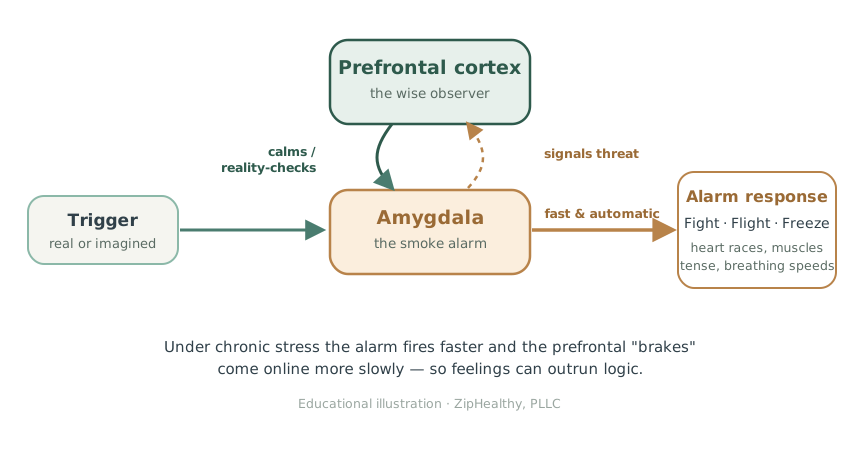
In an anxious brain, two things tend to happen at once: the amygdala becomes more reactive, and the prefrontal cortex is slower to apply the brakes. That is why, in the grip of anxiety, you can know you are safe and still feel in danger. You are not being irrational: your accelerator is simply louder than your brakes in that moment.
The reframe that helps: anxiety is not a character flaw or a lack of willpower. It is an alarm that fires too easily and a brake that engages too slowly, and both can be retrained.
Why your body reacts before you can think
When the amygdala sounds the alarm, it activates the body’s stress-hormone cascade, the HPA axis. The hypothalamus signals the pituitary, which signals the adrenal glands, which flood the body with cortisol and adrenaline. Your heart speeds up, breathing quickens, muscles tense, and blood shifts to your limbs: the classic fight, flight, or freeze response.
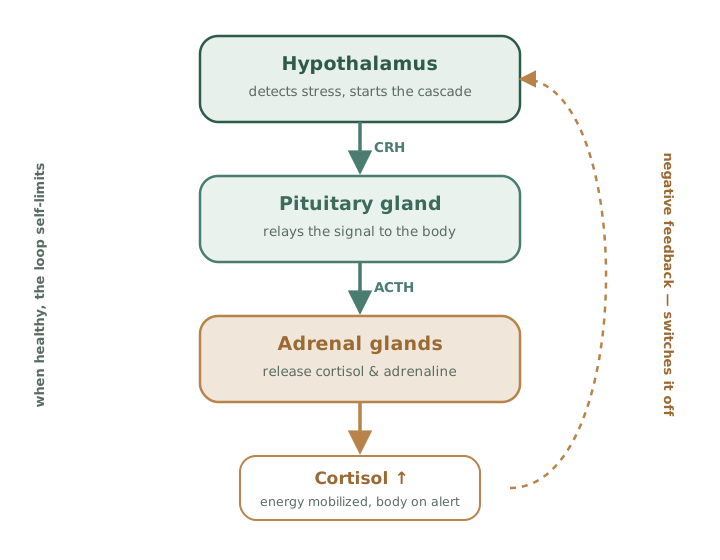
There is a twist that keeps anxiety going. A region called the insula constantly monitors your internal body state. When it notices your racing heart, it can feed that back to the amygdala as more evidence of danger, so the physical symptoms of anxiety become a trigger for more anxiety. This self-reinforcing loop is exactly why panic can seem to come “out of nowhere,” and why calming the body (slow breathing, grounding) can quiet the mind.
“Isn’t anxiety just a chemical imbalance?”
This is one of the most common questions I hear, and the honest answer is more interesting than the myth.
The myth
Anxiety is simply “low serotonin” or a single chemical being out of balance, and the only fix is to correct that chemical.
What the science actually says
Chemical messengers such as GABA (calming), glutamate (activating), serotonin, and norepinephrine absolutely matter. But anxiety is best understood as a whole-circuit pattern shaped by genes, learning, stress, and environment, not one chemical that is “off.”
Why does this distinction matter? Because the circuit view explains something the “imbalance” story cannot: why experience (practicing new responses, facing fears gradually, learning to regulate the body) can change anxiety as powerfully as it does. Your brain is not a chemistry set with one wrong ingredient; it is a living network that learns.
The good news: your brain can rewire
The brain’s ability to change with experience is called neuroplasticity, and it is the scientific reason therapy works. Approaches like cognitive behavioral therapy (CBT) and exposure therapy are not “just talking”: they are structured practice that teaches the amygdala new safety associations and strengthens the prefrontal cortex’s ability to apply the brakes. Over time, the alarm fires less often, and the brakes engage faster.
The brain regions involved in anxiety
Amygdala
The threat detector. Hyper-reactive in anxiety: it sounds the alarm faster and louder.
Prefrontal cortex
The reasoning “brakes.” In anxiety it is slower to calm the amygdala’s alarm.
Hippocampus
Supplies memory and context. Chronic stress can blunt its calming, “you’re safe” signal.
Insula
Senses the racing heart and tight chest, and can feed those sensations back as more fear.
Different anxieties, one shared circuit
Anxiety wears many outfits, but underneath it runs the same amygdala-prefrontal alarm system. Generalized anxiety is the alarm scanning broadly for “what could go wrong.” Social anxiety points the threat detector at being judged. Panic is the alarm firing at full volume, often triggered by the body’s own sensations (via the insula). Phobias attach it to a specific cue, and health anxiety aims it at bodily symptoms. This is good news for treatment: because the underlying circuit is shared, the same core skills (calming the body, facing avoided situations gradually, and strengthening the prefrontal “brakes”) help across all of them.
What this means for getting better
Understanding the circuit changes the goal. You are not trying to delete a faulty chemical or “think your way” out of a feeling. You are retraining a system, teaching the alarm that it can stand down and strengthening the brakes through repetition. For many people that means skills-based therapy; for some it also means coordinating with a physician about whether medication has a role. Both work on the same circuit from different angles.
If anxiety is interfering with your sleep, work, or relationships, that is a sign the alarm is firing more than it should, and it is very treatable. You can take a quick, private anxiety self-check (GAD-7), learn more about anxiety treatment in Bentonville and by telehealth, or read about panic attacks if your alarm sometimes spikes hard and fast. At ZipHealthy, our team of licensed therapists offers a free 15-minute consultation in Bentonville or by secure telehealth across Arkansas: call (479) 259-1390.
Frequently asked questions
Is the anxious brain physically different?
Brain-imaging research consistently finds differences in how the amygdala and prefrontal cortex function in anxiety: the alarm tends to be more reactive and the regulating “brakes” less active. Importantly, these patterns are not fixed; effective therapy is associated with measurable changes in this circuit over time.
Is anxiety genetic or learned?
Both. Genes influence how sensitive your alarm system is, and life experience (stress, modeling, trauma, and what you practice) shapes how it responds. Because learning is part of the picture, new learning (therapy) can change it.
Can therapy really change my brain?
Yes. Through neuroplasticity, structured approaches like CBT and exposure teach the brain new safety associations and strengthen prefrontal regulation. Therapy is, in a very literal sense, practice that rewires the fear circuit.
Do I need medication to “fix a chemical imbalance”?
Anxiety is a whole-circuit pattern rather than a single chemical being off, so there is no one “imbalance” to correct. Therapy is a first-line, evidence-based treatment on its own. For some people, a prescriber may recommend medication as well. That decision belongs with your physician or prescriber; as therapists we coordinate care but do not prescribe.
Why do I feel anxious for “no reason”?
Because the amygdala fires below conscious awareness and the body’s stress response can start before you notice a trigger. Often the “reason” is a subtle cue or a physical sensation (like a fast heartbeat) that the brain reads as danger.
Put it into practice
Inner Peace & Calm Toolkit
Evidence-informed worksheets, coping strategies, and tracking tools for calming an over-alarmed threat system, created by a licensed therapist.
Get the Toolkit: $34.99Instant PDF download · Designed by a licensed clinician
For educational and personal development purposes. Not a substitute for professional therapy.
References
- National Institute of Mental Health (NIMH). Anxiety Disorders. nimh.nih.gov
- American Psychological Association. Anxiety. apa.org
- MedlinePlus, U.S. National Library of Medicine. Anxiety. medlineplus.gov
- Harvard Health Publishing. Understanding the stress response. health.harvard.edu