
Dissociation (feeling detached from yourself, your surroundings, or your memories) is one of the brain’s most misunderstood protective responses. It is not “going crazy.” It is an ancient survival mechanism, and understanding it removes much of the fear. Here is the neuroscience, reviewed by a Licensed Clinical Social Worker.
The brain’s emergency “shutdown”
You may know the fight-or-flight response. Dissociation is part of a third option: freeze/shutdown. When a threat feels inescapable or overwhelming, the brain can down-regulate conscious experience to protect you, numbing pain, blurring time, and creating a sense of watching yourself from outside. In the moment, it is the brain doing its job: getting you through something unbearable.
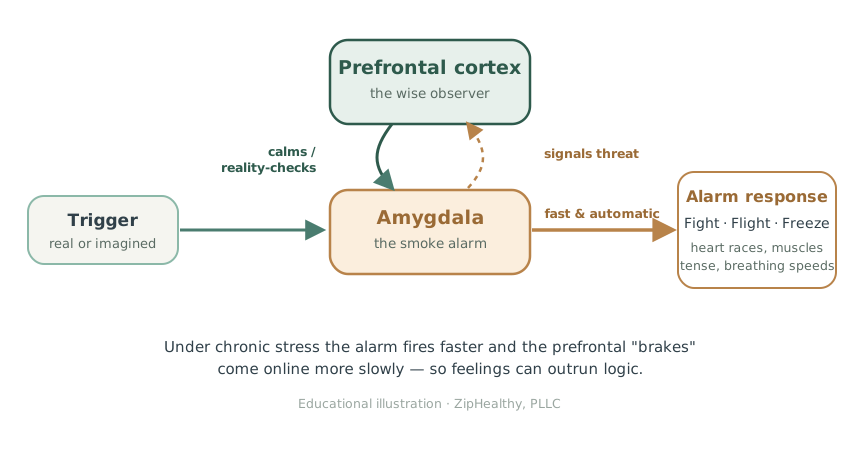
When a protector overstays
Dissociation becomes a problem when the brain keeps deploying it after the danger has passed, triggering detachment, gaps in memory, or feeling unreal during ordinary stress. This is common after trauma, which is why dissociation and PTSD often travel together. The brain learned that shutting down equals safety, and now over-applies the lesson.
The reframe that helps: dissociation is not damage or weakness; it is a protective system that learned to fire too readily. Like other learned patterns, it can be gently retrained so you stay present and safe.
Coming back to the present
Treatment works by teaching the brain and body that the present is safe, so the shutdown response is needed less. Grounding skills bring you back into the here-and-now, while trauma-informed therapy addresses the underlying experiences that trained the response. Over time, the brain learns it no longer has to disappear to cope.
A spectrum, from everyday to clinical
Dissociation isn’t all-or-nothing: it runs along a spectrum. The mild, everyday end is familiar to almost everyone: highway hypnosis, getting lost in a movie, zoning out. Further along sit the more distressing experiences: depersonalization (feeling detached from yourself, as if watching from outside) and derealization (the world seeming unreal, dreamlike, or far away). At the clinical end are conditions involving significant gaps in memory or identity. What changes along the spectrum is not the basic mechanism, the brain’s protective “disconnect”, but how often it fires and how much it disrupts life.
Why it can feel so frightening (and why it’s not dangerous)
Depersonalization and derealization are deeply unsettling: people often fear they are “going crazy” or losing control. Understanding that these are the brain’s protective responses, not signs of breakdown, is itself calming, because much of what intensifies dissociation is the panic about experiencing it. Naming it (“this is my nervous system protecting me, and it will pass”) and gently grounding back into the senses are the first tools, and they work because they signal safety to the very system that triggered the shutdown.
When to reach out
If you regularly feel detached, unreal, or lose time, especially after trauma, trauma-informed therapy can help you feel safe and present again. Our team offers a free 15-minute consultation: call (479) 259-1390. If you are in crisis, call or text 988.
Frequently asked questions
Is dissociation dangerous or a sign of “losing my mind”?
No. It is a common, protective brain response. It becomes a treatable problem when it happens often or outside of real danger, but it does not mean you are losing your mind.
Why does it happen during normal situations now?
After trauma, the brain can learn to trigger shutdown at cues that resemble the original threat, so it fires during ordinary stress. Therapy helps update that learning.
Can it be treated?
Yes. Grounding skills plus trauma-informed therapy help the brain learn the present is safe, so dissociation is needed less over time.
References
- National Institute of Mental Health (NIMH). Post-Traumatic Stress Disorder. nimh.nih.gov
- U.S. Department of Veterans Affairs, National Center for PTSD. Dissociation & trauma. ptsd.va.gov
- National Alliance on Mental Illness (NAMI). Dissociative Disorders. nami.org