
OCD is one of the most misrepresented conditions in everyday language. It is not about loving a tidy desk or being “a little OCD” about neatness. Real obsessive-compulsive disorder is a distressing brain loop: unwanted thoughts that trigger intense anxiety, and rituals performed to make that anxiety stop. Understanding the loop is the first step to breaking it. Here is the neuroscience, reviewed by a Licensed Clinical Social Worker.
A brain circuit that won’t switch off
Deep in the brain, a loop runs between the cortex (which flags “something is wrong”), the basal ganglia (which run habits and gate actions), and the thalamus (which relays signals back up). In OCD, this cortico-striato-thalamic loop gets stuck in the “on” position: the brain keeps generating an urgent error signal (something is wrong, fix it) that won’t turn off, no matter how much you reassure yourself.
The vicious cycle
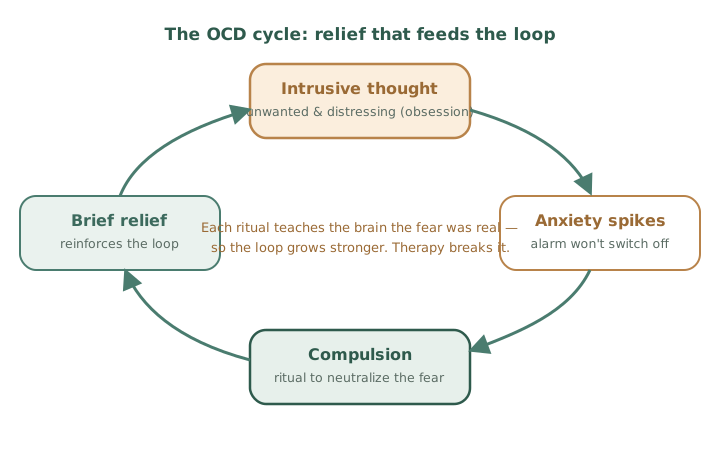
That stuck signal drives a self-reinforcing cycle. An obsession (an unwanted, distressing thought) spikes anxiety; a compulsion (a ritual, check, or mental act) brings brief relief; and that relief teaches the brain that the threat was real and the ritual was necessary, so the loop grows stronger each time.
Everyone has intrusive thoughts
Here is something most people don’t know: intrusive thoughts are universal. Almost everyone has occasional bizarre, disturbing, or taboo thoughts pop into mind. The difference in OCD is not the thoughts themselves but how the brain reacts to them, treating a random thought as a meaningful threat that demands action. That is why people with OCD are often deeply ethical people tormented by thoughts that horrify them.
The myth
OCD just means you like things clean, neat, and organized.
What the science says
OCD is a distressing brain-loop disorder of obsessions and compulsions. The content is often not about cleanliness at all (it can involve harm, morality, relationships, or symmetry), and the rituals are driven by anxiety, not preference.
Breaking the loop: how treatment rewires it
The most effective treatment for OCD is a specific therapy called Exposure and Response Prevention (ERP). ERP works directly on the brain loop: you gradually face the trigger without performing the compulsion, which teaches the brain that the anxiety falls on its own and the feared catastrophe doesn’t happen. Each repetition weakens the loop: neuroplasticity in action. It is challenging, but it is also one of the most effective treatments in mental health.
The many faces of OCD
Because the disorder is a loop rather than a topic, OCD can attach to almost any theme. Common ones include contamination (germs, illness), harm (fear of hurting someone), checking (locks, stoves, mistakes), symmetry and “just right” feelings, scrupulosity (moral or religious fears), relationship doubts, and “Pure O”, where the compulsions are mostly mental (reviewing, reassuring, neutralizing) and invisible from the outside. Different content, identical brain loop, which is why the same treatment works across themes.
Why reassurance backfires
Here is a counterintuitive but crucial point: reassurance is a compulsion. Asking “are you sure I didn’t do something wrong?” or endlessly Googling symptoms brings the same brief relief as any ritual, and teaches the brain the same lesson: the fear was real and needed neutralizing. That is why well-meaning reassurance from loved ones, or compulsive checking online, tends to make OCD worse over time. ERP works precisely because it breaks this pattern, sitting with uncertainty instead of resolving it, until the brain learns the alarm can be tolerated and will fall on its own.
When to reach out
If unwanted thoughts and the rituals you use to quiet them are eating up time, causing distress, or running your day, that is the OCD loop, and it is highly treatable. Learn about OCD treatment or read more about intrusive thoughts. Our team offers a free 15-minute consultation: call (479) 259-1390.
Frequently asked questions
Is OCD about being clean and organized?
Usually not. OCD themes often involve harm, contamination, morality, symmetry, or relationships. Liking things tidy is a preference; OCD is anxiety-driven obsessions and compulsions that cause real distress.
Does having a disturbing thought mean I secretly want it?
No. Intrusive thoughts are common and do not reflect your character or desires. In OCD, the distress comes precisely because the thoughts clash with your values.
Why don’t my compulsions make the anxiety go away for good?
Because relief is temporary and reinforces the loop; each ritual signals to the brain that the threat was real, so the obsession returns. Breaking that cycle (through ERP) is what creates lasting relief.
Can OCD be treated?
Yes. Exposure and Response Prevention is a highly effective, evidence-based therapy, and for some people a prescriber also recommends medication. Many people experience major improvement.
Put it into practice
OCD Management Toolkit | ERP & CBT
ERP-based exercises, hierarchy builders, and response-prevention tools designed by a licensed therapist.
Get the Toolkit: $44.99Instant PDF download · Designed by a licensed clinician
For educational and personal development purposes. Not a substitute for professional therapy.
References
- National Institute of Mental Health (NIMH). Obsessive-Compulsive Disorder (OCD). nimh.nih.gov
- International OCD Foundation. About OCD. iocdf.org
- American Psychological Association. Obsessive-compulsive disorder. apa.org
- MedlinePlus, U.S. National Library of Medicine. Obsessive-Compulsive Disorder. medlineplus.gov