
Few experiences are more frightening, or more stigmatized, than psychosis: a loss of contact with shared reality through hallucinations or delusions. Yet psychosis is a treatable medical condition rooted in identifiable brain changes, and early treatment dramatically improves outcomes. Here is a clear, compassionate explanation, reviewed by a Licensed Clinical Social Worker.
Important: psychosis and schizophrenia-spectrum conditions need medical evaluation and ongoing care from a psychiatrist or physician. ZipHealthy provides psychotherapy and coordinates with your medical team: this page is education, and if you or a loved one may be experiencing psychosis, please seek a medical evaluation promptly.
When the brain’s “signal” system misfires
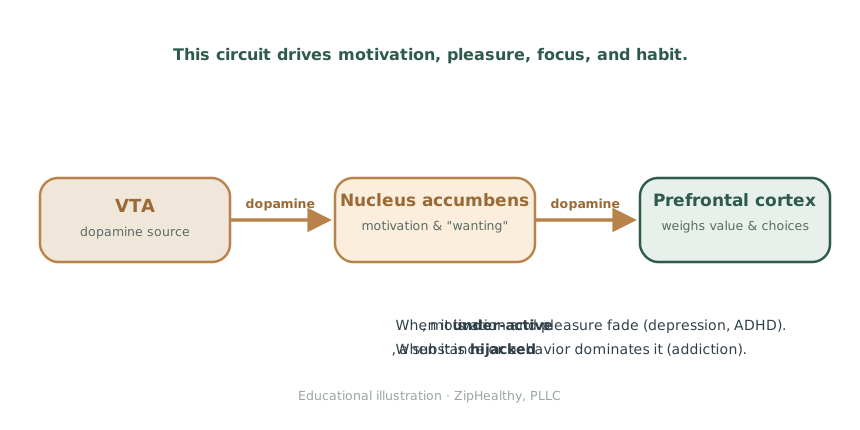
One leading model centers on dopamine, the brain’s signal for “this is important, pay attention.” In psychosis, this salience system appears to misfire, assigning intense significance to ordinary thoughts or perceptions. A passing idea becomes a conviction; a random sound becomes a message. The brain is doing what it always does (tagging importance), but the tagging has gone awry.
More than one system
Psychosis also involves changes in how brain networks communicate, affecting perception, the sense of what is self-generated versus external, and the prefrontal systems behind organized thinking. Genetics, stress, sleep, and substance use can all influence vulnerability. It is not caused by personal weakness or by anything a family “did wrong.”
The myth
Psychosis means someone is dangerous or permanently “broken.”
What the science says
Psychosis is a treatable medical condition. With early, coordinated treatment, many people recover function and live full lives; people experiencing psychosis are far more likely to be vulnerable than dangerous.
Why early treatment matters, and where therapy fits
Outcomes are strongly tied to how early treatment begins. Medical management from a prescriber is the foundation; alongside it, therapy helps enormously, building coping skills, supporting reality-testing, reducing relapse, treating co-occurring anxiety or depression, and supporting families. We work as part of your broader care team.
The early warning signs
Psychosis rarely arrives all at once. There is often a gradual prodrome, subtle changes that precede a first episode: withdrawing from friends, a drop in functioning at work or school, unusual or suspicious thoughts, trouble thinking clearly, or sleep and mood changes. Recognizing this phase matters enormously, because the earlier treatment begins, the better the outcome: a finding so robust it has shaped specialized early-psychosis care programs. If something feels “off” in a young person over weeks to months, it is always worth a professional conversation; acting early is never an overreaction.
How to support a loved one
If someone you love is experiencing psychosis, a few things help: stay calm and non-confrontational, don’t argue with the content of a delusion or try to convince them it isn’t real (and don’t pretend to agree), focus on feelings and safety, and help connect them to medical care. Your steady presence and willingness to help them get evaluated can change the course of their illness. Families do far better with support too, which is part of what therapy provides.
When to reach out
If you or someone you love may be experiencing hallucinations, delusions, or disorganized thinking, seek a medical evaluation promptly: early help changes the trajectory. We can provide therapy and help coordinate care. Call (479) 259-1390. In an emergency call 911, or call/text 988.
Frequently asked questions
Is psychosis the same as schizophrenia?
No. Psychosis is a symptom (loss of contact with reality) that can occur in several conditions, including schizophrenia, but also bipolar disorder, severe depression, medical illness, and substance use. Diagnosis requires medical evaluation.
Can people recover?
Yes. With early, coordinated treatment, many people recover function and live full, meaningful lives. Early intervention notably improves outcomes.
Does therapy help, or is it only medication?
Medical management is the foundation, but therapy adds real value: coping skills, relapse prevention, treating co-occurring conditions, and family support. The two work together.
References
- National Institute of Mental Health (NIMH). Understanding Psychosis. nimh.nih.gov
- National Institute of Mental Health (NIMH). Schizophrenia. nimh.nih.gov
- MedlinePlus, U.S. National Library of Medicine. Psychotic Disorders. medlineplus.gov