
There is no single “mental illness center” in the brain. Instead, the conditions we treat (anxiety, depression, trauma, ADHD and the rest) emerge from how a handful of brain regions and networks communicate. Understanding these few key players makes the whole landscape of mental health far less mysterious. Here is a plain-language map, written and reviewed by a Licensed Clinical Social Worker.
The emotional core: the limbic system
Deep in the center of the brain sits the limbic system, a set of structures that handle emotion, memory, and the body’s stress response. It is where most mental-health stories begin.

The regions that matter most
Amygdala
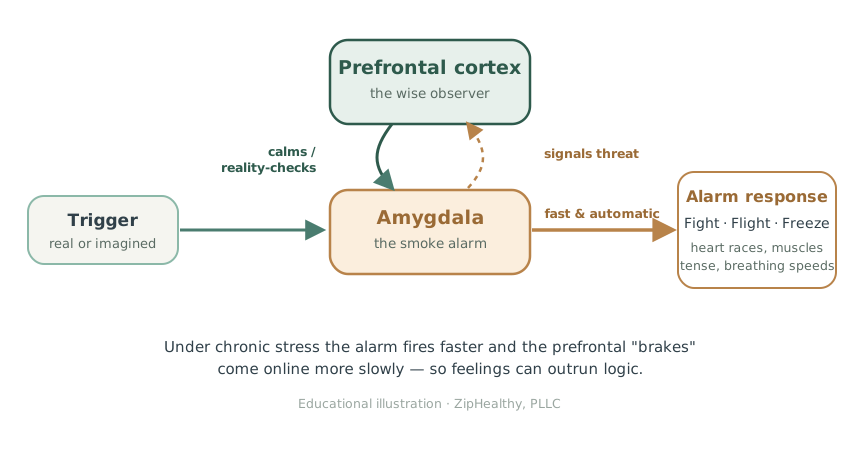
The brain’s smoke alarm. It scans for threat and triggers fear and the fight-or-flight response: central to anxiety, panic, and trauma.
Prefrontal cortex
The reasoning “brakes” behind your forehead. It plans, regulates emotion, and reality-checks the amygdala’s alarm. Slower to develop in ADHD; under-active in many conditions.
Hippocampus
Stores memory and supplies context (“you’ve been safe here before”). Sensitive to chronic stress; central to PTSD.
Anterior cingulate cortex
Monitors conflict and error and helps direct attention, involved in OCD, depression, and focus.
Insula
Senses the internal body state (a racing heart, a tight chest) and shapes how those sensations are felt as emotion.
Basal ganglia & reward circuit
Drive motivation, habit, and reward through dopamine: key to ADHD, addiction, and the loss of pleasure in depression.
The accelerator and the brakes
Across almost every condition, one dynamic recurs: a fast, emotional accelerator (the amygdala) and a slower, regulating brake (the prefrontal cortex). Mental-health symptoms often reflect this balance tipping: an alarm that fires too easily, a brake that engages too slowly, or both.
The body in the loop: the stress axis
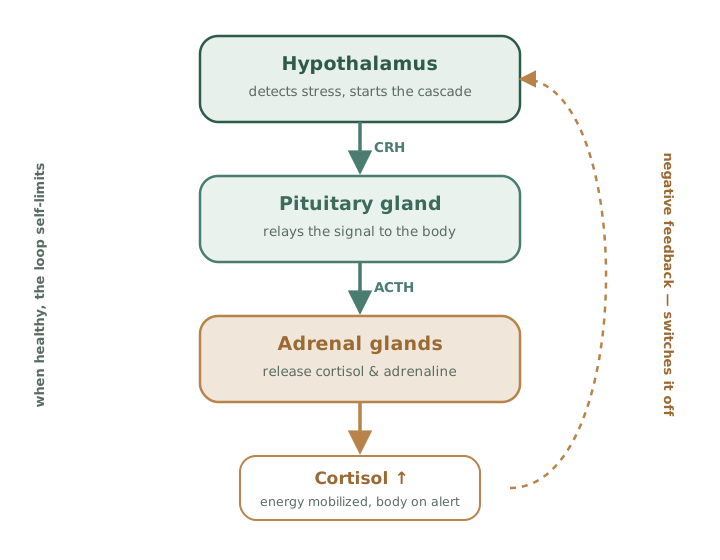
The brain doesn’t stop at the neck. Through the HPA axis, the brain commands the body’s stress hormones, which is why emotional states produce a pounding heart, tense muscles, and disrupted sleep, and why chronic stress reshapes the brain over time.
It’s networks, not just regions
Modern neuroscience has moved beyond “one region, one job.” These structures work as networks that switch on and off together. Three matter for mental health. The salience network (anchored by the amygdala and insula) decides what deserves your attention: it runs hot in anxiety. The executive control network (prefrontal cortex) does focused, goal-directed thinking: it is taxed in ADHD and depression. And the default mode network hums in the background when your mind wanders; when it gets “stuck,” it shows up as the repetitive, self-focused rumination common to depression and anxiety. Many symptoms are really a problem of balance and switching between these networks.
How the brain maps onto common struggles
None of these conditions lives in a single spot, but each has a characteristic signature in how these regions communicate:
- Anxiety & panic: an over-reactive amygdala and a slower prefrontal brake, amplified by the insula reading the body’s alarm.
- Depression: dampened reward circuitry (less pull toward pleasure and motivation) plus an over-active rumination network.
- Trauma & PTSD: a sensitized amygdala and a hippocampus that struggles to file a memory as “past,” so it keeps feeling present.
- ADHD: later-maturing prefrontal control and altered dopamine signaling in the brain’s motivation circuits.
- OCD: an over-active error-and-alarm loop between the cortex and deep basal-ganglia structures that won’t switch off.
We explore each of these in depth on the Brain & Mental Health hub.
The unifying idea: mental-health conditions are not moral failings or a single broken part. They are patterns in how these regions and networks communicate: patterns shaped by genes, experience, and stress, and ones that can change with the right support.
The good news: the brain keeps changing
Every one of these regions can be reshaped by experience: a property called neuroplasticity. It is the reason therapy works and the reason recovery is possible. Learn more about how therapy changes the brain, or explore how specific conditions affect these circuits on our Brain & Mental Health hub.
Frequently asked questions
Is there one part of the brain responsible for mental illness?
No. Mental-health conditions arise from how multiple regions and networks communicate, not from a single “broken” area. That is why treatment focuses on patterns and circuits, not one spot.
Does knowing the brain science change treatment?
It can make treatment make sense. Understanding that anxiety is an over-active alarm, or that depression dampens reward circuitry, helps explain why specific therapy skills and, for some people, medication are effective.
Can these brain patterns change?
Yes. Through neuroplasticity, experience, including therapy, reshapes these circuits over time.
References
- National Institute of Mental Health (NIMH). Brain Basics. ninds.nih.gov
- MedlinePlus, U.S. National Library of Medicine. Brain Diseases & the Limbic System. medlineplus.gov
- American Psychological Association. Understanding psychotherapy and how it works. apa.org
- Harvard Health Publishing. Understanding the stress response. health.harvard.edu