
Anger that erupts faster than you can stop it, impulsive acts you regret moments later: these can feel like character flaws. More often they are a brain operating with a strong accelerator and weaker brakes in the moment. Understanding that balance is the first step to changing it. Here is the neuroscience, reviewed by a Licensed Clinical Social Worker.
Accelerator vs. brakes
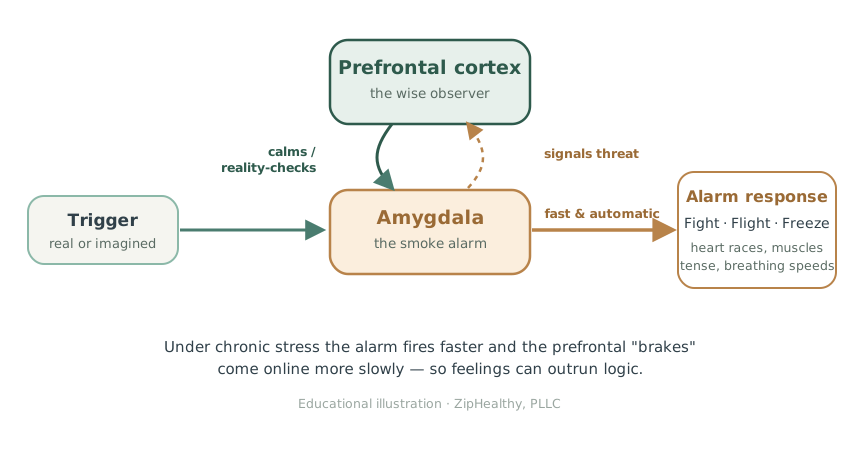
Impulsive and explosive behavior reflects the balance between the brain’s fast emotional and reward systems, the amygdala and the reward circuit, and the slower, regulating prefrontal cortex. When the accelerator fires hard and the prefrontal brakes are slow or under-developed, action outruns reflection: the urge becomes the deed before the “should I?” arrives.
Why willpower alone falls short
In the heat of the moment, the very part of the brain you would use to “just control yourself” (the prefrontal cortex) is the part that is briefly overpowered. That is why telling someone to try harder rarely works, and why skills that intervene before the peak, and that strengthen regulation over time, work far better.
The reframe: impulsivity and anger aren’t about being a “bad person.” They’re a regulation skill the brain can build; with practice, the brakes get stronger and engage sooner.
How therapy strengthens the brakes
Because regulation is a trainable brain skill, therapy helps. Approaches like CBT, DBT, and anger-specific skills work on recognizing early cues, widening the gap between urge and action, and building the prefrontal regulation that impulsivity bypasses. Over time, through neuroplasticity, the pause gets easier to find.
What’s usually underneath anger
Anger is often a secondary emotion, the brain’s fast, protective response to a more vulnerable feeling underneath: hurt, fear, shame, or feeling disrespected or unsafe. The amygdala reacts to that vulnerability with a surge of mobilizing energy (anger feels powerful, where the underlying feeling feels exposed). This is why anger so often masks something softer, and why effective work goes beneath the explosion to the threat or hurt that set it off. Naming the underlying feeling actually engages the prefrontal cortex, which helps quiet the alarm.
Skills that work with the brain, not against it
Because the regulating prefrontal cortex briefly goes offline at the peak, the most effective anger skills act early, catching the body’s warning signs (heat, tension, racing heart), creating a genuine pause, and discharging the activation (a walk, slow breathing, stepping away) before acting. Over time, therapy widens the gap between trigger and response, so the pause becomes more available when it counts.
When to reach out
If anger or impulsive actions are costing you relationships, work, or peace of mind, that pattern can change. Our team offers a free 15-minute consultation: call (479) 259-1390. If you are in crisis, call or text 988.
Frequently asked questions
Why can’t I control my anger in the moment?
Because at the peak of emotion the prefrontal cortex, the part that regulates, is briefly overpowered by the fast emotional response. Skills that work before that peak, plus training over time, are what help.
Is impulsivity just immaturity?
No. It reflects the balance between fast reward/emotion systems and slower prefrontal control, which varies between brains and can be strengthened with practice.
Can it really change?
Yes. Emotion regulation is a trainable brain skill; therapy builds it, and the brakes engage sooner over time.
Put it into practice
Emotional Mastery Toolkit | DBT & ACT
DBT- and ACT-based tools, de-escalation strategies, and emotional regulation exercises designed by a licensed therapist.
Get the Toolkit: $34.99Instant PDF download · Designed by a licensed clinician
For educational and personal development purposes. Not a substitute for professional therapy.
References
- American Psychological Association. Anger. apa.org
- National Institute of Mental Health (NIMH). Disruptive Mood Dysregulation Disorder. nimh.nih.gov
- MedlinePlus, U.S. National Library of Medicine. Impulse Control Disorders. medlineplus.gov