
Sleep is not downtime: it is some of the most important work your brain does. During sleep the brain consolidates memories, clears metabolic waste, regulates emotion, and resets the stress system. When sleep breaks down, nearly every part of mental health is affected. Here is what is happening in the brain, reviewed by a Licensed Clinical Social Worker.
What your brain does while you sleep
Across the night the brain cycles through stages, each with a job. Deep (slow-wave) sleep restores the body and clears waste; REM sleep processes emotion and weaves memories together. This is why a poor night leaves you not just tired but emotionally raw: the brain hasn’t had its chance to file the day and settle the alarm system.
The two-way street between sleep and mental health
Sleep problems and mental-health conditions feed each other. A stressed, anxious brain keeps the HPA axis, the stress-hormone system, switched on, making it hard to fall and stay asleep. And lost sleep makes the amygdala more reactive and the prefrontal cortex less able to regulate it the next day, amplifying anxiety, low mood, and irritability. It is a loop, and a powerful place to intervene.
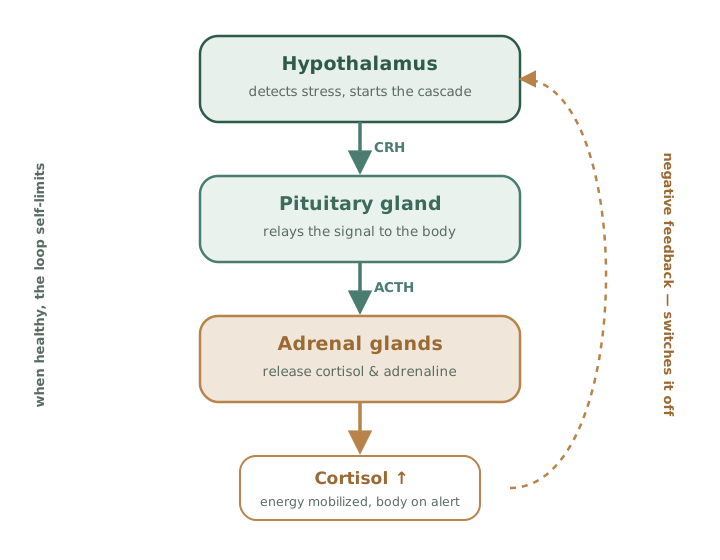
Why this matters for treatment: because sleep amplifies or calms almost everything else, improving sleep is one of the highest-leverage moves in mental health, and insomnia has its own highly effective, non-medication therapy.
Insomnia is a learned brain pattern, and it can be unlearned
Chronic insomnia is often maintained by the brain learning to associate the bed with wakefulness and worry rather than sleep. The most effective treatment, CBT-I (cognitive behavioral therapy for insomnia), retrains those associations and the body clock, and research shows it works as well as or better than sleep medication over the long term, without the downsides. That is neuroplasticity applied to sleep.
Giving your sleep-brain what it needs
Because sleep is driven by two systems, a body clock (circadian rhythm) and a sleep drive that builds the longer you’re awake, the most effective sleep habits work with that biology. Consistent wake times anchor the clock; morning light sets it; avoiding long daytime naps protects the sleep drive; and a wind-down routine signals safety to the nervous system. Crucially, getting out of bed when you can’t sleep (rather than lying there frustrated) protects the brain’s association between bed and sleep: the very association insomnia erodes. These aren’t just “tips”; they are levers on the circuitry that controls sleep.
When to reach out
If sleep has been hard for weeks, or daytime life is suffering for it, that is worth addressing directly, both for sleep’s sake and for everything it touches. Our team offers a free 15-minute consultation in Bentonville or by telehealth across Arkansas: call (479) 259-1390.
Frequently asked questions
Why does poor sleep make my anxiety or mood worse?
Sleep loss makes the amygdala more reactive and the prefrontal cortex less able to regulate it, so emotions feel bigger and harder to manage the next day.
Is it better to treat insomnia with therapy or medication?
For chronic insomnia, CBT-I is recommended as the first-line treatment and tends to outperform medication over the long term. A prescriber can advise whether medication has a short-term role; that decision belongs with your physician.
Can fixing sleep really improve other conditions?
Often, yes. Because sleep regulates emotion and stress, improving it frequently eases anxiety and depression symptoms as well.
Put it into practice
Insomnia & Sleep Toolkit | CBT-I
CBT-I based sleep tools, sleep-hygiene guides, and relaxation exercises designed by a licensed therapist.
Get the Toolkit: $24.99Instant PDF download · Designed by a licensed clinician
For educational and personal development purposes. Not a substitute for professional therapy.
References
- National Institute of Mental Health (NIMH). Caring for Your Mental Health (sleep & well-being). nimh.nih.gov
- MedlinePlus, U.S. National Library of Medicine. Insomnia. medlineplus.gov
- Harvard Health Publishing. Understanding the stress response. health.harvard.edu